
The skepticism was earned
For a long time, serious boxers looked at Everlast with quiet skepticism. The most famous name in the sport had drifted: you would see the gloves on someone walking into their first boxing-fitness class, or on a pro under the lights - and in that second case, it was hard not to wonder whether the gloves were there because they were chosen, or because the check cleared.
So when the new 1910 Collection started showing up across social feeds with real marketing weight behind it, I paid attention. From the outside, at least, this finally looks like a different brief than the usual mass-market lane. Here is why that matters - and what still has to be proven in the gym.
Why “1910”?
The name earns its place. In 1910, Jacob Golomb founded Everlast in the Bronx; the brand’s early story runs through swimwear before boxing gear took over after work with fighters like Jack Dempsey. The 1910 series is a straight nod to that founding year - more than a century of history folded into a product line.
Whether the glove lives up to that story is something only hands-on rounds can answer. But the lineage hook is real, not hollow word salad. That already separates this launch from a generic “new colorway” drop.
Two different gloves, one confusing name
Before you search “Everlast 1910” and click buy, know this:
- There is an older 1910 Classic line that has been around for a while and sits in a more entry-level tier. This article is not about that line.
- In early 2026, Everlast launched a new 1910 Collection with a different brief: full-grain cowhide, hand stitching, and a development process that reportedly involved real fighters - not just a mood board in a conference room.
The naming does not make that split obvious. If you are hunting the premium pair, shop carefully and confirm you are on the new 2026 collection - ideally from Everlast’s official site or another source you trust - so you do not pay premium money for the wrong SKU.
For everything we already score on FightGearLab, our Everlast brand hub lists reviewed models separately from this opinion piece.
The Crawford factor
Terence Crawford signed with Everlast in May 2017. At that point he was already a two-weight world champion, but not yet the generational figure he became. He stayed with the brand through the climb - and at signing, his language was about support and belief from early in his career, not a late-career logo swap.
What followed is easy to list and harder to fake: an undefeated run, undisputed work across multiple weights, a win over Canelo, 42-0 at retirement, and Everlast still in the corner the whole way. In a sport where sponsors rotate with every contract cycle, long loyalty reads as more than marketing.
That does not prove how the 1910 Pro feels on the bag. It does mean that when someone with Crawford’s credibility is attached to a development story, serious gyms pay attention. This is closer to “fighter co-sign with something to lose” than “logo on a retail glove.”
What the look is telling me
I have not put a pair through our full lab protocol yet. Still, anyone who has handled enough leather knows the silhouette, panel break, and finishing tell you something before the first punch. The new 1910 Pro reads compact and intentional: brown leather, yellow hit on the wrist patch, vintage typography that nods to championship-era gear without looking like a costume. The etched branding stays restrained. It does not read like a committee tried to invent “premium” from a Pinterest board.
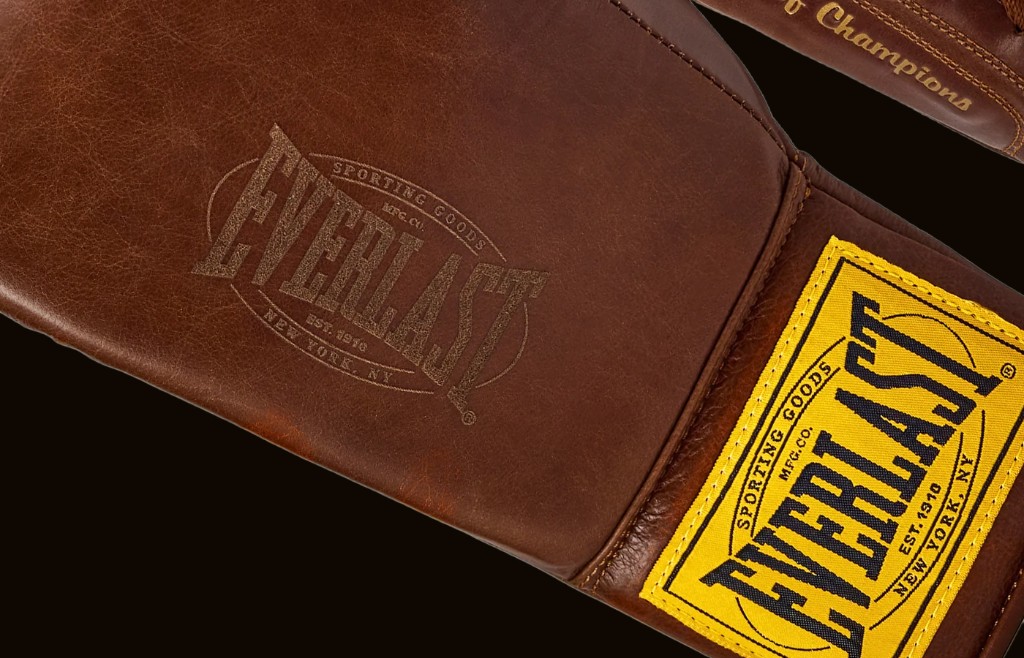
Unboxing a genuinely great glove is its own small ritual - weight in the hand, leather smell, how the cuff sits when you flex. I am not going to pretend I have had that moment with the 1910 yet. I am saying the presentation and materials story line up with how serious brands signal intent. The next step is obvious: bag work, mitts, sparring prep if appropriate, and scoring across the same metrics we publish for every glove we stand behind.
Early numbers (needs verification)
Because the line is new, there is not much independent testing to cite yet - no deep YouTube teardowns, no long-term community wear data. What exists is the public spec sheet, launch materials, and fighter feedback from Everlast’s own development sessions (including comments on the four-layer C4 foam from names like Conor Benn and Zaquin Moses in press around the line). The catalog entries for the lace-up and hook-and-loop SKUs are live on FightGearLab with the same “needs verification” posture until we log real rounds.
Until we get our own hours on them, here is where the 1910 Pro sits in the FightGearLab framework - explicitly tagged needs verification:
| Variant | Overall | Wrist | Knuckle | Durability | Value |
|---|---|---|---|---|---|
| Lace-up | 7.25 | 8 | 8 | 7 | 6 |
| Hook & loop | 7.0 | 7 | 8 | 7 | 6 |
Wrist (lace-up 8): lace construction, ergonomic grip bar, and full-grain leather should, on paper, deliver real lockdown - hence the higher mark than the hook-and-loop pair, where closure physics cap how tight the story can be regardless of build quality.
Knuckle (8 on both): driven mostly by the stated four-layer C4 foam package and the same shell story on both closures.
Durability (7): the materials and stitching sound right, but Everlast still carries a trust deficit in the premium lane until long-term wear proves the point.
Value (6 on both): at around $299.99, these are priced into the same conversation as Winning, Cleto Reyes, and other established flagships. That is bold company for a line that still has to earn its place round by round.
Verdict - for now
From the outside, this is the first Everlast launch in a long time that I actually want to try - not as a nostalgia exercise, but as serious equipment. It also looks like the Everlast that used to belong in real gyms, not only on retail endcaps.
Whether it delivers is still an open question, because price and presentation are not sparring partners. At this tier, Rival, Reyes, Winning, and a short list of others already have years of proof behind them. Aesthetics and a strong co-sign open the door; performance has to walk through it.
One last observation from fight night: watching Benn vs. Prograis with coaches, gym friends, and a few pros, both fighters wore Everlast in the ring - and neither wore the 1910s. That is not a knock; it is a reminder that the visual win still waiting out there is simple: put the brown 1910 leather under real lights on the right card, on the right hands, and let the gyms react the next morning. Reyes and Winning both benefited from that kind of “seen on TV, repeated in the gym” loop. Everlast finally has a glove that looks like it could play that game. Now it has to earn the rounds.
Full FGL-tested review with measured scores is coming once we get a pair in-house. For launch updates and when the lab scores go live, follow @fightgearlab on X.